|
Most consulting firms’ content fails to influence prospects.
On paper, they do everything right:
They invest in articles and posts.
They publish consistently.
And they optimize everything based on the latest tactics.
But then…
Nothing happens.
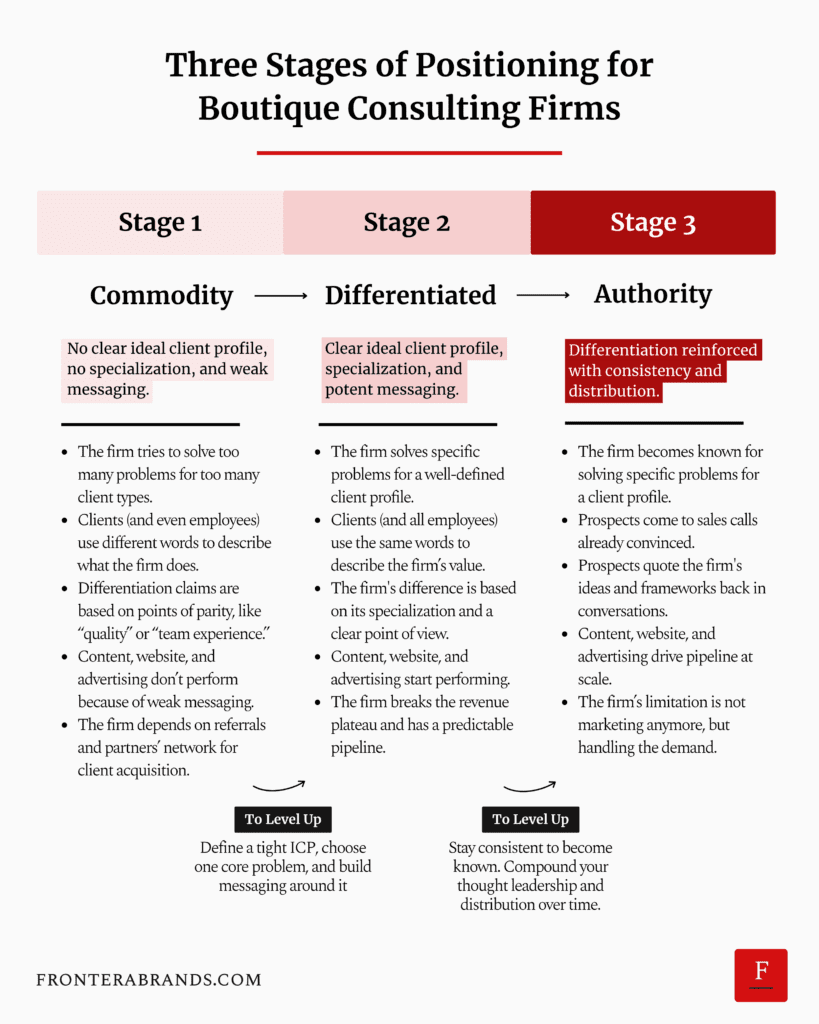
They continue to rely on referrals for growth.
No “We read your articles” on sales calls.
No prospects quoting their ideas back to them.
Why?
Well, because most consulting firms treat content as a mere checklist item.
Something you’re supposed to do for the sake of doing it.
But B2B buyers have high standards today.
They sense who is just a content creator and who is a thought leader.
And consulting firms sell expertise.
They have no other option but to be thought leaders.
Otherwise, why would prospects want to hire them?
So let’s make the distinction between generic content and thought leadership content.
Thought leadership content has to meet certain criteria.
Because it has a purpose: influencing the audience.
And to do that, it has to follow these seven rules:
1. Thought leadership content changes how the audience thinks
Thought leadership content has to give new insights to the audience.
Not information, but insights.
That’s why it’s harder than the usual content.
Information can be easily found, recycled, and styled.
But insights require deep understanding.
That’s what makes them rare.
With insights, the audience gains a new frame to see their situation.
A new way to act.
That builds influence.
2. Thought leadership content makes the audience feel like they cannot get it anywhere else
Thought leaders have a taste for ideas.
And thought leadership content conveys that taste.
The audience feels like they can’t get those insights anywhere else, in that way.
It’s differentiated by its nature.
It infuses insights into content in a way others can’t.
The audience knows that content wouldn’t exist if that thought leader never existed.
3. Thought leadership content attracts both prospects and competitors
I like this quote attributed to Einstein:
“Make things as simple as possible, but not simpler.”
Thought leadership content walks this fine line.
On one side there is simplicity.
On the other side there is depth.
When it’s too simple, it fails to show expertise.
The audience might consume it.
But it wouldn’t build influence.
When it’s too complex, this time it fails to keep attention.
The audience gives up before they even reach the insight.
So effective thought leadership content keeps the right balance of simplicity and depth.
We use one filter to measure this:
A consulting firm’s content has to attract both prospects and competitors.
That proves the right balance:
It’s simple enough to keep the attention of prospects, and deep enough that even a competitor can learn from it.
4. Thought leadership content uses a narrative to make the case
Since thought leadership is about driving a change in behavior, it has to persuade first.
To do that, thought leadership content puts messy ideas into an elegant package.
That package is a narrative.
A narrative helps the audience to quickly grasp what’s going on.
What’s the problem?
What causes it?
What are the consequences of not solving it, and how is it going to be solved?
That way, the audience takes away the insight without effort.
Most consulting firms try to force-feed useful but messy ideas to their audience.
But it never works.
Because the audience has no patience to decipher the mess.
And there are always other shiny packages waiting for their attention.
5. Thought leadership content might not always be a masterpiece, but it’s consistently good
Seth Godin has been writing his blog since 2002.
And he has written more than 20 books.
Are all of his blog posts and books masterpieces?
Not really.
Do all of his blog posts and books meet a quality threshold?
Definitely.
Even when he posts just a few sentences.
So not every thought leadership content has to be a masterpiece.
But you can’t afford any to be bad.
Because the audience never forgives that.
It leaves a bad taste in their mouths and a negative association in their minds.
It kills their enthusiasm to look forward to the next one.
And the thought leader loses all the influence that took years to build.
6. Thought leadership content has a high signal-to-noise ratio
The audience is busy.
The audience has emails to respond to, meetings to attend, and other content to consume.
So thought leadership content always has a high signal-to-noise ratio.
It doesn’t mean it has to be short.
But every word has to earn its place.
The audience shouldn’t feel the need to “summarize” it with AI.
Because they know the content is already so dense, they’d miss insights.
They trust the thought leader.
Because the thought leader sacrifices their own time to save time for the audience.
Some thought leaders go to the wrong side of this ratio.
That’s when the audience doesn’t see them as a thought leader anymore, but a content creator.
7. Thought leadership content is designed for relevance
Thought leadership starts with a choice.
Choosing a certain topic to create thoughts on, for a certain audience.
Because the audience craves relevance.
They are tired of broad advice.
They are tired of content creators who jump from topic to topic.
They want insights that apply to their situation.
That’s why they follow thought leaders who talk directly to them.
Their industry.
Their role.
Their problems.
The words they use.
This relevance makes the audience follow the thought leader.
And that’s why thought leadership content doesn’t chase reach, but relevance.
The moral of the story?
Some consulting firms don’t do justice to their expertise.
They produce content they wouldn’t consume themselves.
And they blame channels when it doesn’t work.
What they miss is that prospects don’t separate content from the brand.
Your content is how they judge your thinking.
And your thinking is what they’re buying.
Share this article
What “New Year’s Resolutions” have you set for your firm?
“More clients.”
“Higher revenue.”
“A consistent pipeline.”
All of them are fine goals for 2026.
But the problem is how to turn them into reality.
How will you influence more right-fit prospects?
Well, one thing is clear.
If you continue with what you’ve done in the last year, you’ll probably get similar results.
What got you here won’t get you there.
You have to change something.
So to achieve your firm’s goals:
Would it be a bad idea to get clear on your firm’s value and message?
We help consulting firms define what makes them different and bring it to market with clear messaging. Following our engagement, you end up with:
- A positioning that makes "why you?" easy to answer
- Messaging that makes your value concrete
- A brand narrative that makes prospects think "these people get my problem"
- A brand ideology your team can actually get behind
- Homepage copy that turns visitors into leads
- A go-to-market plan to get in front of the right people without depending on referrals
It takes around 4-5 weeks.
From there, we continue as your ongoing partner for thought leadership content or guide your team to execute the strategy.
Serious about achieving your firm’s goals for 2026?
Fill out this form. Let’s chat.
You can reply to this email with your thoughts and feedback. I'd be happy to hear from you — I read and reply to all messages.
And you can connect with me here on LinkedIn.
Have a great day.
Ozan
Founder - Frontera
|