|
Some boutique consulting firms are still doing marketing like it’s 2010:
They rely on their partners’ networks for new business.
They post some random content.
And they occasionally hire an agency to do mass outreach campaigns.
These tactics worked fine 15 years ago.
But the world has changed since then.
Going through a pandemic.
The AI wave.
Smartphone ownership levels and social media usage.
Everything is different.
And together with the world, how B2B buyers buy high-value services has also changed.
They have different preferences now.
So to do marketing effectively, consulting firms have to align with today’s buyer behavior.
How?
Here are 5 changes in buyer behavior with some interesting research and what it means for your firm:
1. Buyers want to get information themselves now
Sales used to be simple.
Buyers depended on salespeople to get information.
Salespeople had fancy pitches and decks.
All information gathering and sales happened in meetings.
Well, not anymore.
Buyers want to research on their own before talking to vendors today.
They consume an average of 11 pieces of content¹ (articles, webinars, case studies) before any meeting.
They go through their social media profiles and websites.
So they complete 83% of the decision process² before talking to vendors.
Sure, “sales” meetings still happen.
But buyers don’t use those meetings to get information or make a decision anymore.
They use them to validate what they’ve already researched.
So those meetings are becoming a formality.
What it means for your firm:
- Marketing is taking over sales: Marketing isn’t just for awareness anymore. It’s also 80% of your sales process. Buyers decide if they should work with your firm through your website and content. See your website and content as your salespeople.
- Help buyers through clarity: The problem you solve, who you serve it for, how you solve it differently… Make everything so clear that you almost repel your non-ideal prospects. That way, the right buyers can immediately say: “Yes, this is for us.”
- Cater to their awareness levels: Most buyers are not ready to buy today. Some of them are not even aware of their problem. Give granular information in your content ecosystem to handle their objections over time. Make your firm the guide in their buying journey.
2. Buyers buy from experts who change their perspectives
Back in 2010, there was little content online.
Even content with basic ideas was sufficient to build visibility.
But today, things are different.
Buyers raised their bars.
They want to consume content before buying.
But they also demand differentiated content.
73% of decision-makers³ say that an organization’s thought leadership content is more trustworthy to assess its competency than its promotional materials.
86% of hidden decision-makers⁴ within organizations want fresh perspectives and ideas that challenge their assumptions from providers.
So today, buyers buy from experts with a new and strong point of view.
What it means for your firm:
- Produce differentiated content: Buyers don’t get fooled by average content anymore. They want content they can’t find anywhere else. And they make purchase decisions based on content quality. Produce content that’s worth your expertise. Because your content’s quality signals the quality of your work.
- Change your buyers’ perspective: Buyers want to take sides today. They want to go against what everybody else is doing. So repeating what everybody else is saying is not enough. Offer original ideas. Take sides. Develop your brand ideology and infuse it into your marketing.
- Stay top of mind: Buyers don’t say “we have to buy from this firm” after reading a single piece of content. It takes multiple pieces of opinionated content to change their perspective. Design your marketing to influence your prospects over time. Thought leadership is a marathon.
3. Buyers want to buy from specialists
Power resided in big, generalist firms back in 2010.
They had large armies and resources.
They were known.
So buyers bought from them.
But this is changing.
Today, buyers want to work with specialists.
They care less about how many employees a firm has or how well they are known.
They care if they are known for something.
Because they want high odds of success before any purchase.
And specialists offer the highest odds.
They understand the buyers’ industry and context.
That’s why boutique firms are rapidly increasing their market share⁵, while generalists are struggling.
That’s why buyers rank subject-matter expertise⁶ as the top criterion for their vendor selection.
Even above team quality, past experience, and price.
What it means for your firm:
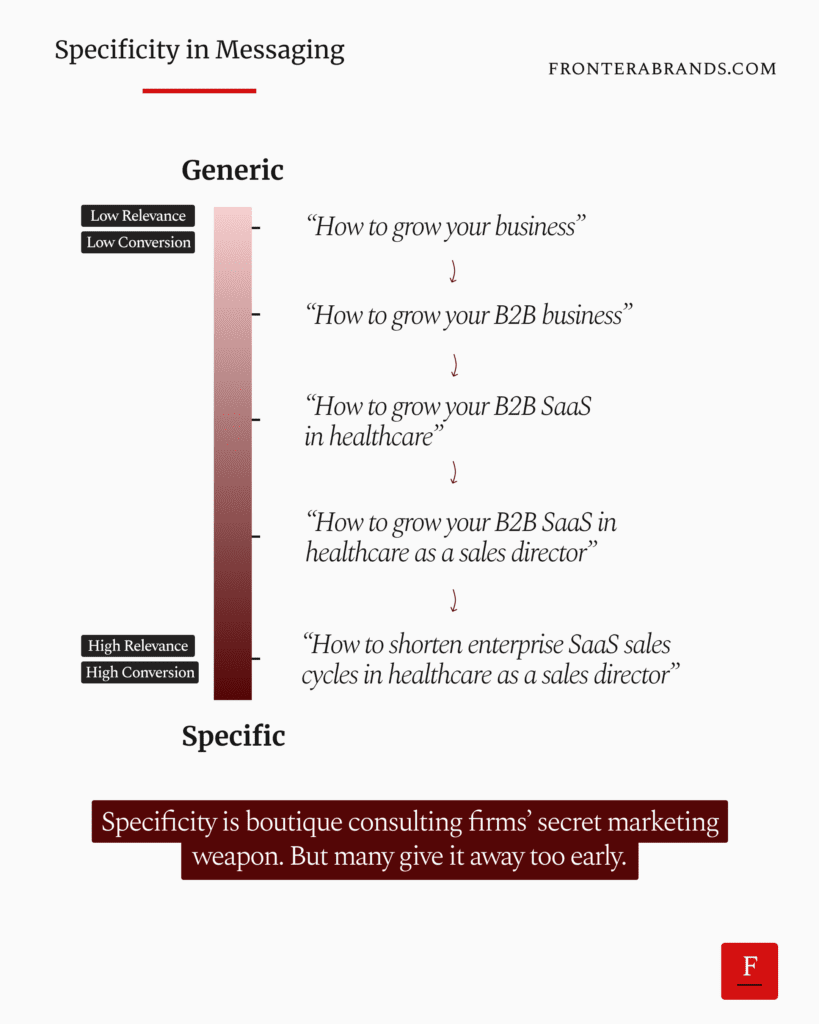
- Get narrow with your positioning: Buyers are starving for specialists. There has been no better time to tighten your ideal client profile and the services you provide for them. Your conversion and win rate will increase magically.
- Chase depth over numbers: Buyers prefer detailed, niche insights over broad commentary to assess credibility. Give them what they want. Associate your firm with specific problems in a specific area. Show the depth of your expertise with the depth of your ideas.
- Convey your specialization clearly: Being specialized is one thing. Communicating it is another. Call out your tight ideal client profile and the problems you solve at every opportunity in your marketing channels. Drop generic definitions like “tech companies” or “leaders” from your firm’s messaging. Never let your buyers think: “Is this firm really for us?”
4. Buyers ignore interruptions
Interruption is everywhere in today’s world.
Endless robocalls.
Annoying emails and DMs from companies you’ve never heard of.
So buyers have become resistant.
But what’s interesting is that they don’t only ignore those interruptions.
73% of buyers actively avoid suppliers who send irrelevant outreach⁷.
It erodes those firms’ reputation in their eyes.
Buyers want to have full control over the buying process.
They want to discover niche thought leaders they can learn from, follow their ideas, and buy when they are ready.
What it means for your firm:
- Earn buyers’ attention: There is no easy way to earn buyers’ trust today. Earn their attention through your specialization and thought leadership over time. The long way is the shortcut.
- Avoid tactics that irritate buyers: Negative associations push away buyers. Don’t make your firm associated with annoying outreach tactics. 5 calls you book with random prospects don’t justify 9,995 real buyers you irritate forever.
- ‘Push’ with value: There are two ways to make “interruption” marketing work today: Extreme personalization or ‘pushing’ with value. We’ve talked about examples here. If you are going to interrupt, do it the right way.
5. Buyers still value referrals, but in a different way
A reference from a trusted person was enough for buyers to take a sales meeting before.
And referrals still work today.
But in a different way.
Buyers don’t blindly jump into sales meetings anymore.
Referrals initiate the discovery.
Following the reference, buyers go and review that firm’s website, articles, and social media.
They rely on their own research process, as discussed above.
So references still open doors.
But what you tell on your marketing channels closes the deal.
Plus, there are more and more indirect referrals.
It doesn’t come from clients.
It comes from the audience who follows your ideas.
They share what they find useful with relevant people they know.
And those people eventually become buyers.
84% of B2B decision makers begin their buying process with a referral⁸ today.
What it means for your firm:
- Make sales calls a formality: Everything we talked about in the first point applies here. Even referrals validate if you are the right fit through your messaging. Have a clear, consistent messaging strategy and put your marketing channels to work. Make sales calls a formality for referrals.
- Ignite referrals through content: Besides your client work, your through leadership is also a referral engine now. Give enough importance to your content. Make it specific to get relevant fame. So your ideas can get shared in small, but highly connected circles. And you can get more organic referrals.
- Repeat intentional “keywords”: Referrers should be able to describe your firm easily to others. Choose keywords that make your positioning clear immediately (e.g., messaging for consulting firms, pricing strategy for B2B SaaS). Repeat them again and again throughout your marketing to build associations. Make it easy for referrers to refer you.
-
The moral of the story?
Buyer behavior has changed a lot in the last 15 years.
The patterns are obvious.
Buyers want to be in control of the buying process.
They want clarity.
They want niche expertise.
And they want original ideas.
So no need to insist on outdated tactics that don’t work anymore.
No need to fight their preferences.
Make things easy for your firm.
Align your marketing to how buyers buy today.
Share this article
Your pipeline problem is a messaging problem. Let's fix both
We help boutique consulting firms define what makes them different and bring it to market with clear messaging.
So you stop depending on referrals, fill your pipeline consistently, and hear prospects say: "This is exactly what we need."
Want to stop losing sales to weak messaging?
Fill out this form, let's chat.
In case you missed it:
You can reply to this email with your thoughts and feedback. I'd be happy to hear from you — I read and reply to all messages.
And you can connect with me here on LinkedIn.
Have a great day.
Ozan
Founder - Frontera
References:
¹ https://sopro.io/resources/blog/b2b-buyer-statistics-and-insights/
² https://www.gartner.com/en/sales/insights/b2b-buying-journey
³ https://www.edelman.com/expertise/business-marketing/2021-b2b-thought-leadership-impact-study
⁴ https://www.edelman.com/expertise/Business-Marketing/2025-b2b-thought-leadership-report
⁵ https://www.intelmarketresearch.com/business-consulting-services-2025-2032-735-6060
⁶ https://hingemarketing.com/library/article/inside-the-buyers-brain-fourth-edition-executive-summary
⁷ https://www.gartner.com/en/newsroom/press-releases/2025-06-25-gartner-sales-survey-finds-61-percent-of-b2b-buyers-prefer-a-rep-free-buying-experience
⁸ https://www.wbresearch.com/relationship-between-b2b-buying-content-sales-changed-insights
|