♦️ How to use emotional outcomes to make your messaging resonate
|
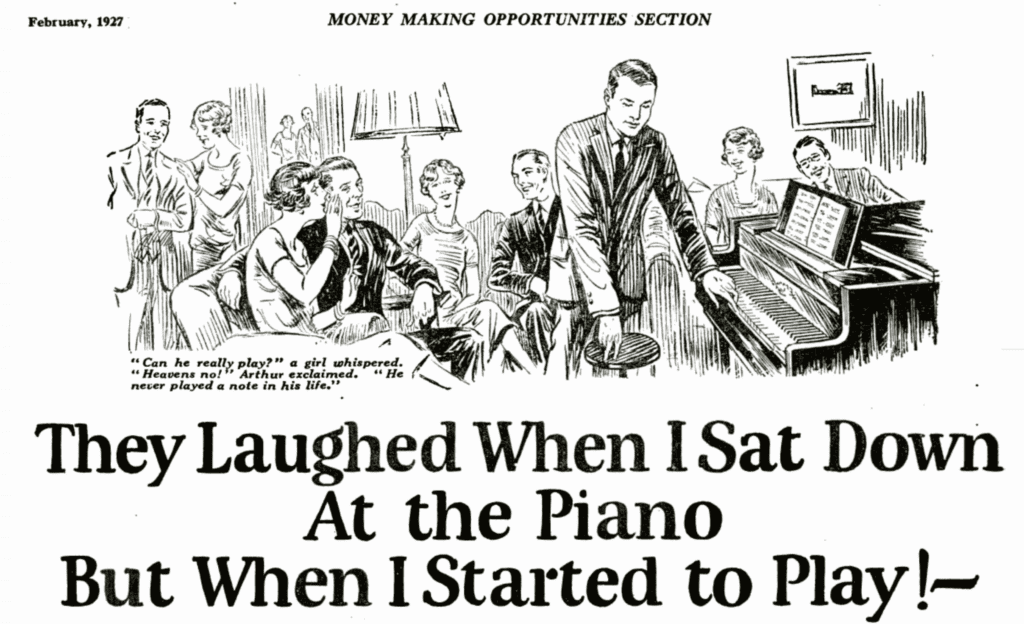
In 1925, a rookie copywriter named John Caples had to sell something hard to sell: A mail-order piano course. He was barely a year into his job at the agency Ruthrauff & Ryan. The U.S. School of Music had knocked on their door. They wanted a campaign for their new self-study instrument courses. Caples needed an angle for his copy. Should he focus on how easy it makes learning? Should he focus on the lower price compared to hiring a tutor? Both were true. But none of it felt compelling. Caples asked himself: Why would someone who isn’t a professional musician want to learn piano in the first place? What would they really want to achieve? And he realized the answer had nothing to do with music. People who wanted to learn to play an instrument were after admiration. They wanted to walk into a room, sit at the piano, and watch people’s jaws drop. They wanted a moment in the spotlight. If they were going to buy that course, this was the main reason. Everything else was secondary. So Caples decided to base his copy on this emotion. He created a scene where people underestimated the main character, a guy who had never played piano before. “Can he really play?” But then he plays like a pianist. Everybody is shocked. They surround our guy: “Where did you learn?” “How long have you studied?” “Who was your teacher?” Only then does Caples start explaining the functional details of the mail-order course. And as the finishing touch, he wrote one of the most famous headlines in advertising history: “They Laughed When I Sat Down at the Piano—But When I Started to Play!”
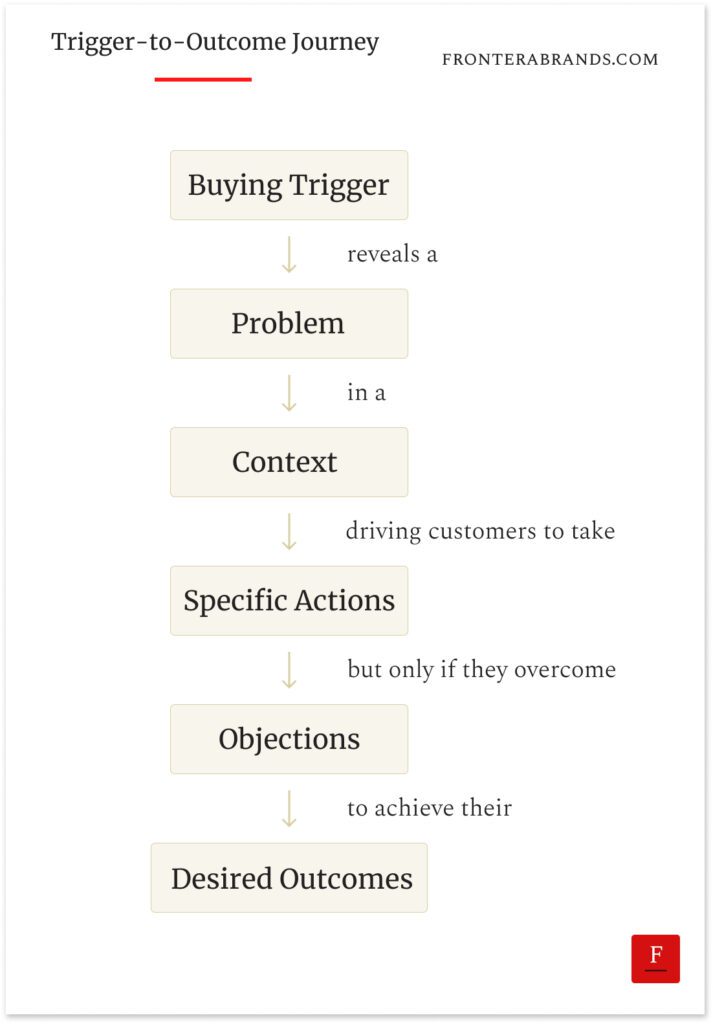
It made Caples a copywriting legend. And that ad is still studied by copywriters today. Why? Because Caples understood one thing: Functional outcomes are only vehicles to achieve underlying emotional outcomes. If you sell the emotion, you sell the product. Understanding what your clients actually buyYou know the jokes about big consulting firms. “McKinsey sells overpriced PowerPoints.” Totally justified. Their quality dropped over the years while they kept charging outrageous fees. But the jokes miss one point. If these big firms have average quality, why do buyers still pay millions to them? Are they naive? Of course not. They are actually smart. But it’s like Caples’s realization with piano course buyers. Their reasons are more emotional than functional. Sometimes they want the least risky option. Sometimes they want to use a known firm’s credibility to gain more power internally. We’ve talked about why B2B buyers act even more on emotions than consumers. But despite this, most consulting firms never try to understand what their buyers actually try to achieve. Hence they base their messaging purely on functional outcomes. Increase revenue this much. Decrease costs that much. Sure, these matter. But they are only vehicles for the underlying emotional outcomes. So ignoring them in your messaging makes it bland. It stays at the surface level. To make your messaging connect, you have to understand what they actually want to achieve. How? Well, by seeing the world from their perspective. As we talked about in 3C Analysis, we use the Trigger-to-Outcome Journey in our framework to understand why clients really buy.
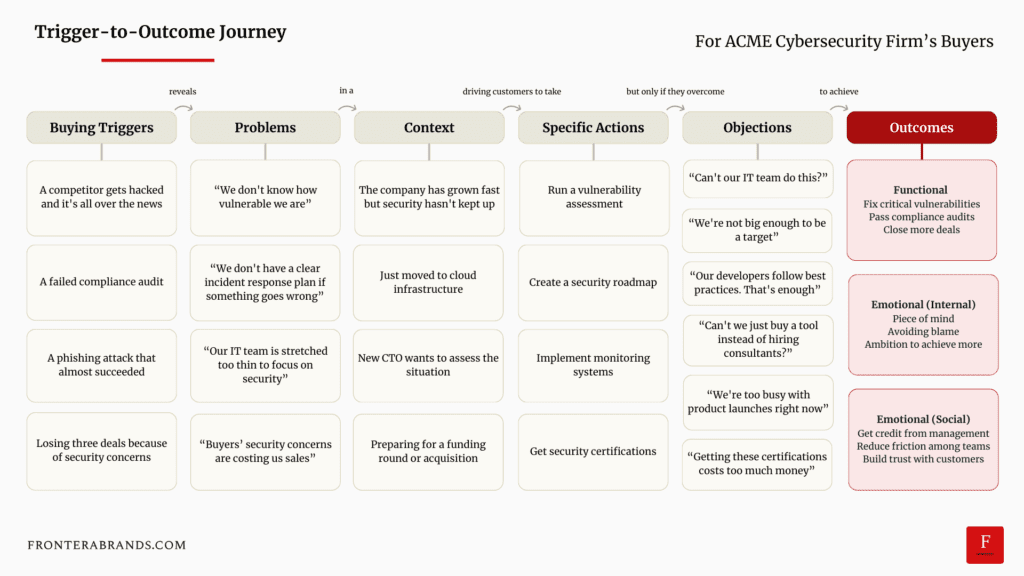
Like past engagements, client interviews, and sales meeting transcripts. We identify the key themes and list them under each part of the journey. Let me show you an example. Imagine a cybersecurity consulting firm called ACME. After analyzing everything, let’s say we’ve mapped out these points for ACME’s buyers:
Great. This gives an overall view of what ACME’s clients are trying to achieve. Now, how do we use this analysis for positioning and messaging? In three ways: 1. Pair it with segmentationDifferent customer segments care about different problems and outcomes. Let’s say ACME has some enterprise clients and some mid-market ones. The enterprise segment might care more about reducing personal risk if a breach happens. While the mid-market segment might care about being perceived as a serious partner to win deals, hence ambition. So if we position ACME for the mid-market, we have to align messaging to their needs. Messaging based on reducing risk wouldn’t work well. Because these buyers care about something else. 2. Pair it with Company and Competition AnalysisCustomer analysis is only one of the 3Cs we analyze. The other Cs are Company and Competition. Customer analysis tells you what matters. Company analysis tells you where you have an edge. Competition analysis tells you what others ignore. The combination of all three allows us to make an informed positioning decision in our workshops. Continuing with our example:
3. Make decisionsDuring the analysis stage, we list as many points as possible without making assumptions. So we end up with dozens of “problems” and “outcomes.” But then we have to prioritize the most important ones. This part is tricky. Because this is where we make decisions, hence sacrifices. Saying “yes” to a few problems means saying “no” to many others. But it’s vital to have effective messaging. The decisions here shape everything. Website copy, content, ads… If we were to position ACME for the enterprise segment, focusing on risk reduction:
If we were to position ACME for the mid-market segment, focusing on ambition:
You see how everything changes. The same firm. But totally different value propositions. These decisions always lead to interesting discussions between executives during our workshops. Sometimes it becomes like a therapy session. Everybody shares their opinions about what the firm should stand for. But in the end, decisions are made. So everybody is aligned around the value the firm creates for clients. --- The moral of the story? Caples’s ad worked because he understood why people actually buy. The same applies to your firm. Yes, you deliver functional outcomes for your clients. But so do your competitors. To stand out, own certain emotional outcomes. And communicate them better. Caples sold admiration, not piano lessons. The question is: What are you really selling? "We struggle to express our real value through our content and website..."You’re great at what you do. Your clients love you. But new prospects? They don't get it. They don't see why they should choose you from your website or content. You know why? Because to them, your value is only as good as your messaging. When it's weak, you become just another provider in their eyes. And that costs you deals you could have won. We help boutique consulting firms define what makes them different and infuse it into their website and content. So you finally get your marketing machine working and hear prospects say: "This is exactly what we need." Want to stop losing sales to weak messaging in 2026? Fill out this form, let's chat. And you can connect with me here on LinkedIn. Ozan |
Frontera
Join 10,000+ B2B founders getting the strategies of iconic brands.
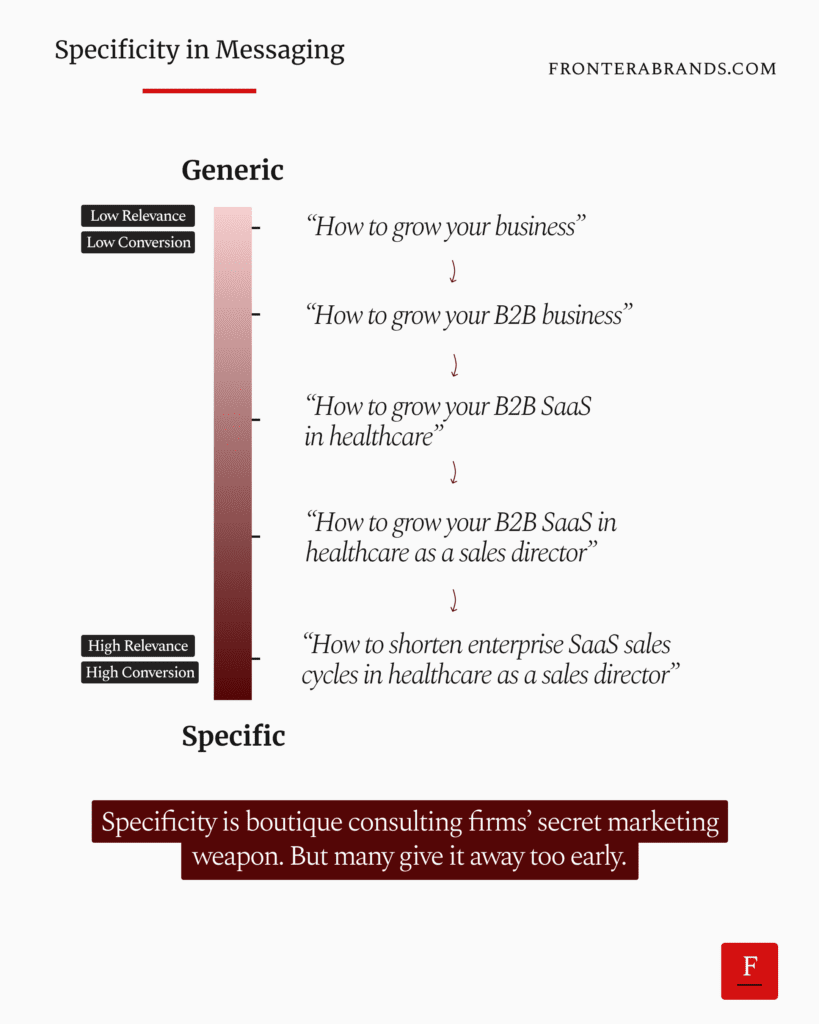
Boutique consulting firms have a secret marketing weapon that larger firms lack. It’s specificity. Let me explain with an example. Look at this: The more specific you get, the more relevant your firm becomes to a specific audience. They intuitively say: “This is for me.” So among dozens of other things trying to catch their attention, they have to click that one. And if they like what they see, they check your firm’s site and social profiles. If what they see there is also specific, they want...
Your consulting firm’s ‘unique’ methodology is not as unique as you think. I know. You’ve refined it meticulously after many client engagements, solving the same problems many times, and turning your firm’s collective experience into a repeatable system. But your competitors also have one. They also gave it a nice name. They are also boasting about the results it delivers. Put yourself in the buyer’s shoes. You have a business problem to solve. You’ve found some consulting firms. And all...
I hear this complaint often from consulting firms: “Organic reach is down. Even our followers don’t see our posts on social media anymore. And Google stopped sending us traffic.” Unfortunately, this eventually happens on every organic channel. The algorithm always changes. Sometimes it starts pushing more ads. Sometimes it starts pushing new content types. Because the algorithm always serves its owner. It’s not our friend. It doesn’t owe us anything. That’s why it doesn’t make sense to depend...