♦️ Why consulting firms can't scale while chasing every client size
|
The size of a consulting firm’s clients shapes everything about that firm. Think about it. All these depend on the size of the clients you serve:
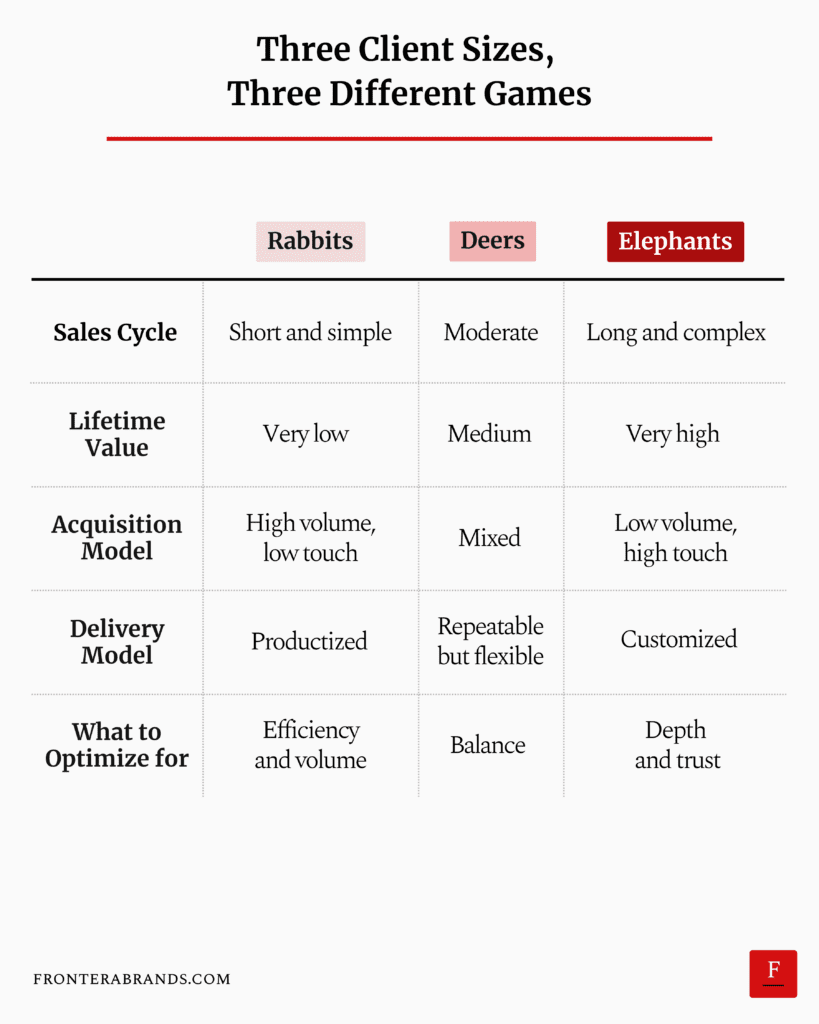
B2B salespeople usually refer to different client sizes as Elephants, Deers, and Rabbits. Rabbits are small clients. They don’t have big budgets. So if you are serving them, you have to chase volume. You need to “hunt” as many of them as possible to build a thriving firm. Because your average lifetime client value will be low. And they won’t be sticky as small businesses are less stable. That means you cannot spend too much to acquire a single client, nor to deliver the service. You have to optimize costs. And have a marketing model built for volume to get as many Rabbits as possible. On the other side of the spectrum, we have Elephants. These are large enterprise clients. The “dream” of every consulting firm. They have big budgets. And they are sticky as long as your firm delivers good service. Your average lifetime client value is as high as it gets. So you can spend a lot to acquire them, and still be highly profitable. But those dream clients also bring some nightmares. Long sales cycles, bureaucracy, RFPs… Plus, they usually require customization for their needs. So even if you try to systemize everything, you still end up using more resources to acquire them and deliver the service. And in between Elephants and Rabbits, we have Deers. Deers are the middle-sized clients. They have some pros and cons from both sides. You probably don’t have to deal with RFPs, but you also can’t earn as much as you would from an Elephant client. Their sales cycles are not that long, but still not as easy as Rabbits.
Because they take whatever client comes through the door to survive early on. A referral brings in a Deer. The founder’s personal connection becomes an Elephant client. And there are always some Rabbits as they are easy to hunt. But even after they pass that survival stage, they don’t sacrifice certain client profiles to specialize in one. So now the firm starts running three businesses in one. One side needs to optimize costs and productize. The other side needs to customize and win on quality. So margins compress. Because the team is over-serving Rabbits to keep them happy while not delivering enough for Elephants. Marketing and sales become a mess. Hunting Rabbits requires volume and speed. Hunting Elephants requires tight targeting and nurturing. And hunting Deers requires a bit of both. Plus, they require different messaging, since they have different needs. A Rabbit wants to know if you can solve their problem fast and cheaply. An Elephant wants to know if you can be trusted with a complex, high-stakes engagement. Sales cycles drag because partners are context-switching between deal types. And the firm wonders why scaling feels so hard. How to fix this? Well, it’s simple but not so easy for many consulting executives. Because it requires a choice. Serving different client sizes means playing different games. You can win by choosing either. But you cannot win playing all at the same time. At least not until your firm reaches $100m+. So look at your client list. If you’re trying to hunt Elephants, trap Rabbits, and chase Deers at the same time, you’re making scaling harder than it needs to be. Pick the game you want to play. And from marketing to delivery, build your firm around it. Because when it comes to your ideal client profile, size matters.
|
Frontera
Join 10,000+ B2B founders getting the strategies of iconic brands.
There’s a quote attributed to John Maynard Keynes: “It is better to be roughly right than precisely wrong.” I see how this plays out in the way consulting firms approach marketing. There are two types of firms: Directionally right and precisely wrong ones. What drives precisely wrong firms is their need for certainty. Uncertainty is scary. But business and marketing are uncertain domains by their nature. That’s why their executives cling to some beliefs and playbooks. And they over-optimize...
Something surprises me every time I talk to consulting firm executives. They all have proprietary frameworks refined over years of client work. Their clients are impressed by their expertise. But none of that comes through their content. So there is a disconnect between what prospects see and these firms’ real expertise. Why does this happen? Why can’t all these consulting firms full of deep expertise seem to convey it? From what I see, there are three main reasons: 1. Intellectual Property...
Most boutique consulting firms can get more return from their marketing by cutting things out. Nassim Taleb calls this Via Negativa. It means the negative way in Latin. Instead of adding new things to achieve a goal, you cut things out. You get to the solution not through addition, but subtraction. I’ve realized a lot of the advice we give to our clients follows this. Especially the firms that had already been investing in marketing without enough ROI. Because most firms try to do, offer, and...