♦️ Why some consulting firms never build real authority (and how to fix it)
|
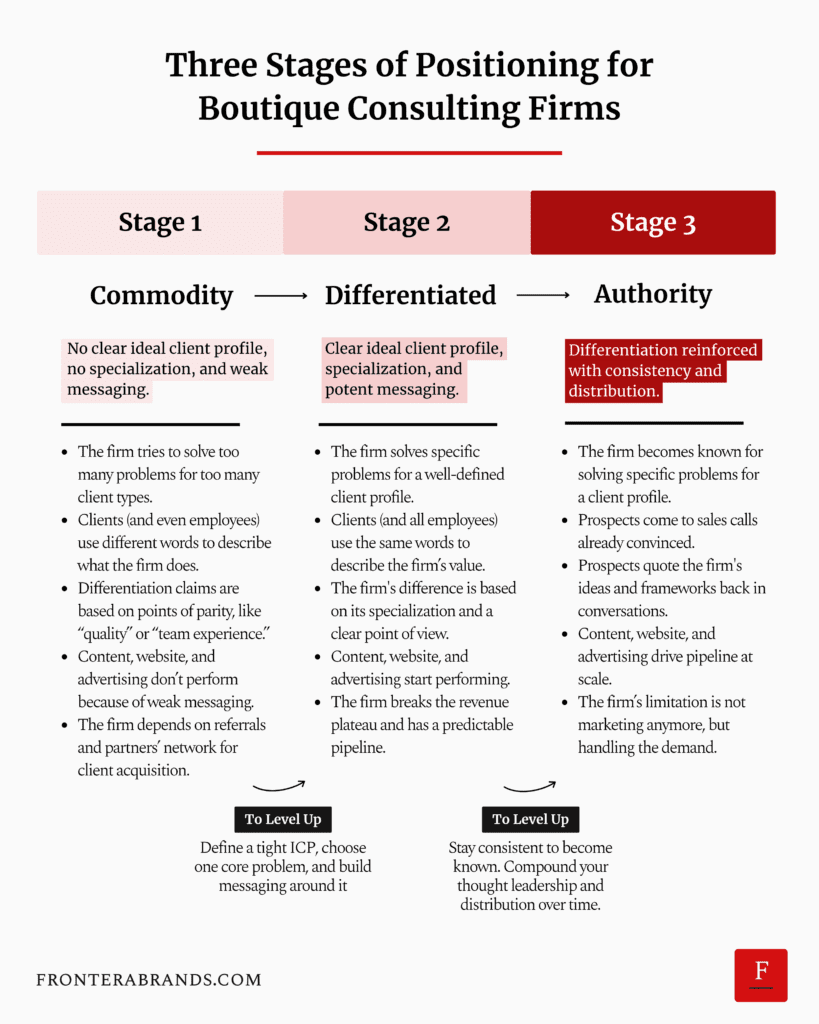
Every boutique consulting firm wants to be seen as an authority. But most skip a stage that makes authority possible. That stage is choosing what to be known for. Think about it. Most consulting firms start by saying yes to every type of client and project. Because at the beginning, it’s about survival. But what keeps you alive at that early stage is the same thing that keeps you stuck later. You survive, but you hit a ceiling you can’t explain. Clients and even employees use different words to describe what the firm does. Content and marketing channels underperform because you try to talk to too many client types about too many problems. Buyers push back on price because they don’t see your firm as the specialist. That’s the Commodity stage. Most firms stay here for years. They try to jump to the Authority stage with more content and visibility. But it never works. Because first, they have to go through the Differentiated stage. Instead of adding, they have to cut out things:
Because it means letting go of the “just in case” clients and projects. But only then does the firm open the path to becoming an authority. The firm’s difference becomes based on a real specialization. Prospects get to see the firm’s value on every marketing channel. The firm overcomes the revenue plateau. And when you stay consistent with that over time, you reach the Authority stage. So if your firm has been stuck for some time, the answer probably isn’t more of doing the same. It’s deciding what to be known for first. And having the discipline to stick with it. Your firm does exceptional work. So why does growth still feel like a grind?It usually comes down to three things: Prospects can't find you or hear from you consistently (distribution). They don't understand your expertise and value through your content (messaging). They can't tell what makes your firm different (positioning). We help consulting firms solve all three. Following our engagement, you end up with:
From there, we continue as your ongoing partner for thought leadership content or guide your team to execute the strategy. Want a pipeline that finally matches the quality of your work? Fill out this form. Let’s talk.
|
Frontera
Join 10,000+ B2B founders getting the strategies of iconic brands.
Back in 2008, I started going to the gym. I loved it. Lifting weights, discovering different exercises, the feeling after a good training… I loved it so much that in a few years I became very muscular. People thought I was using steroids. Because not many people went to the gym, knew training programs, or ate right. Now I see young guys who are the age I was in 2008. They are all muscular. They have their straps and belts for weightlifting. And they know what they are doing, much more than I...
There’s a quote attributed to John Maynard Keynes: “It is better to be roughly right than precisely wrong.” I see how this plays out in the way consulting firms approach marketing. There are two types of firms: Directionally right and precisely wrong ones. What drives precisely wrong firms is their need for certainty. Uncertainty is scary. But business and marketing are uncertain domains by their nature. That’s why their executives cling to some beliefs and playbooks. And they over-optimize...
Something surprises me every time I talk to consulting firm executives. They all have proprietary frameworks refined over years of client work. Their clients are impressed by their expertise. But none of that comes through their content. So there is a disconnect between what prospects see and these firms’ real expertise. Why does this happen? Why can’t all these consulting firms full of deep expertise seem to convey it? From what I see, there are three main reasons: 1. Intellectual Property...